Vito PalumboComposer
Poetics

Sound, light, matter: a poetics of transformation

Following the postmodern explorations of his early period, Palumbo turned to music theatre and the possibilities of the voice, investigating modes of production, phonemes and the relationship between sound and gesture in works including Butterfly, Cinque di Cuori, Il Catalogo, Sinforosa, La machine de sons, Comuni-Canti and Les Animaux.

His recent output focuses on large-scale form and on new possibilities of orchestral colour and texture. Violin Concerto, Clarinet Concerto, Piano Concerto, Recorder Concerto, Double Concerto for Guitar and Marimba, Drops, Fragile and Dark Clouds conceive form as an organic network of interconnected and interdependent moments and gestures.

Timbre understood as colour leads to the idea of sound-light, developed through the convergence of electronics and instruments in Chaconne and through extended techniques integrated into orchestral writing. An interest in astronomy directs this research towards an abstract sonic core articulated in large, single-movement spans: a continuous cosmic energy of which the listener perceives one circumscribed point.

Sound is not an inert object in Palumbo’s music but a living process. A cell is set in motion, attracts neighbouring figures, changes density and gradually generates its own temporal environment. Form is heard as growth, resistance, sedimentation and metamorphosis rather than as the application of a pre-existing scheme.

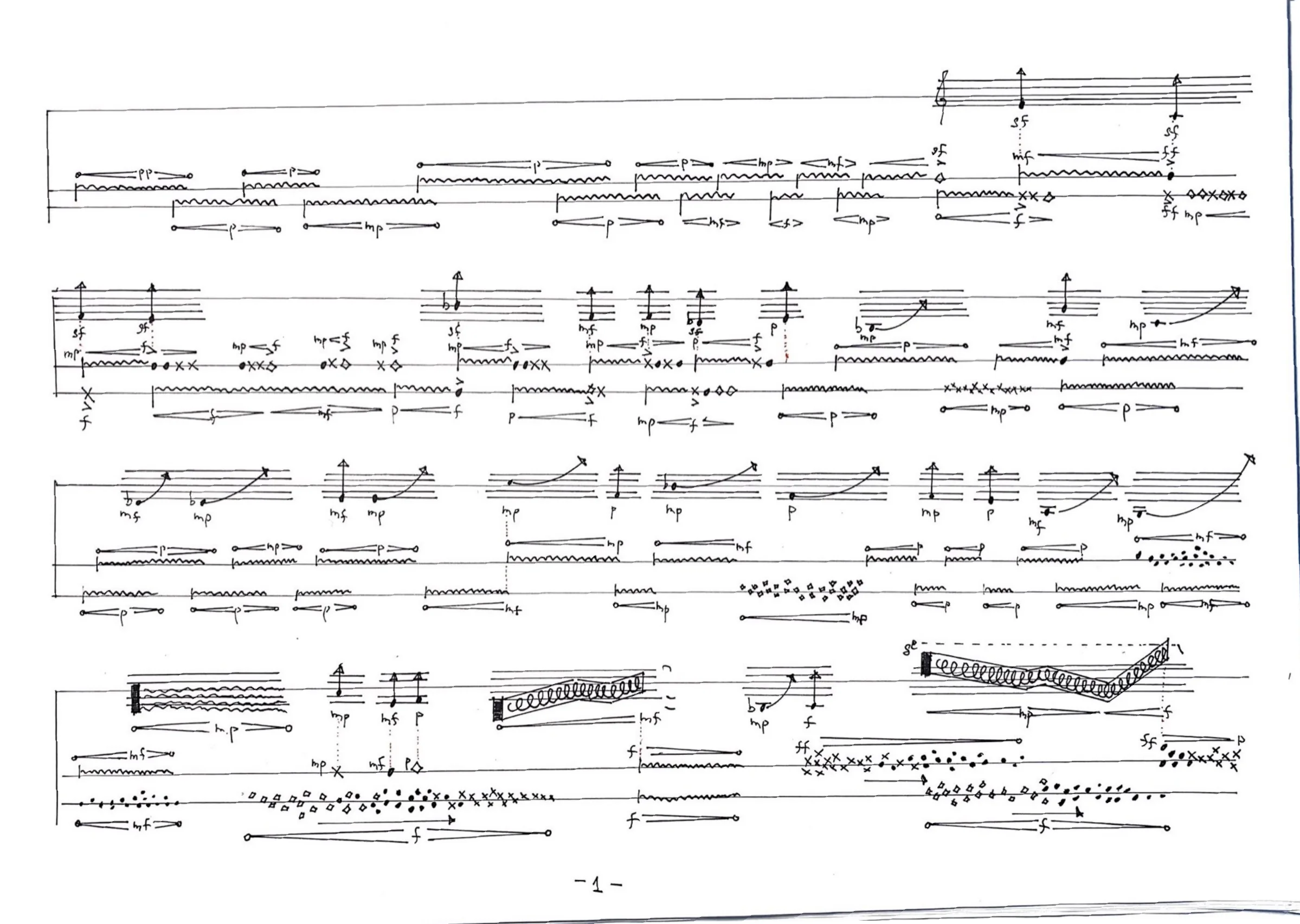
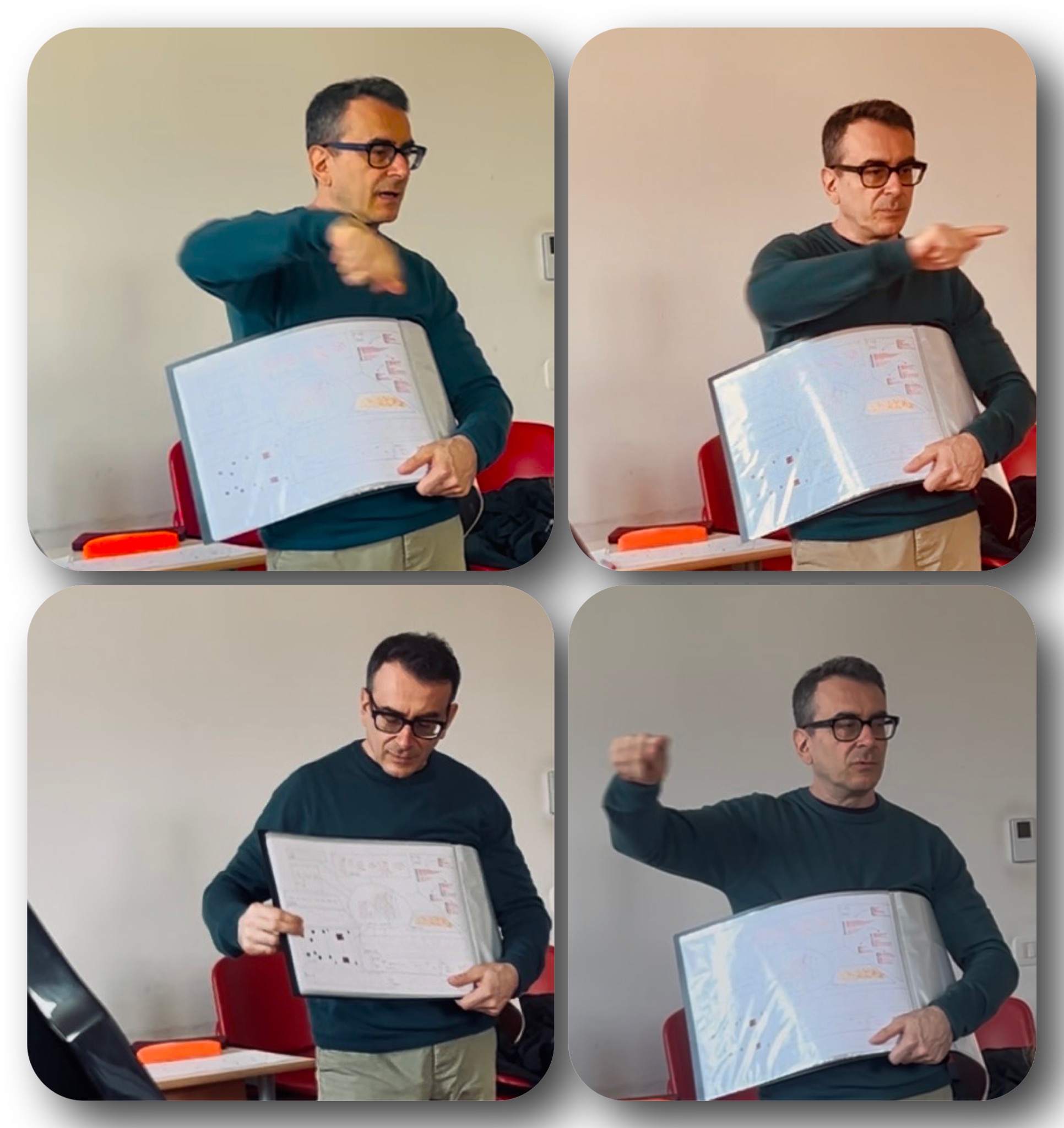
Vito Palumbo presenting a score through four gestures
Artistic cycles
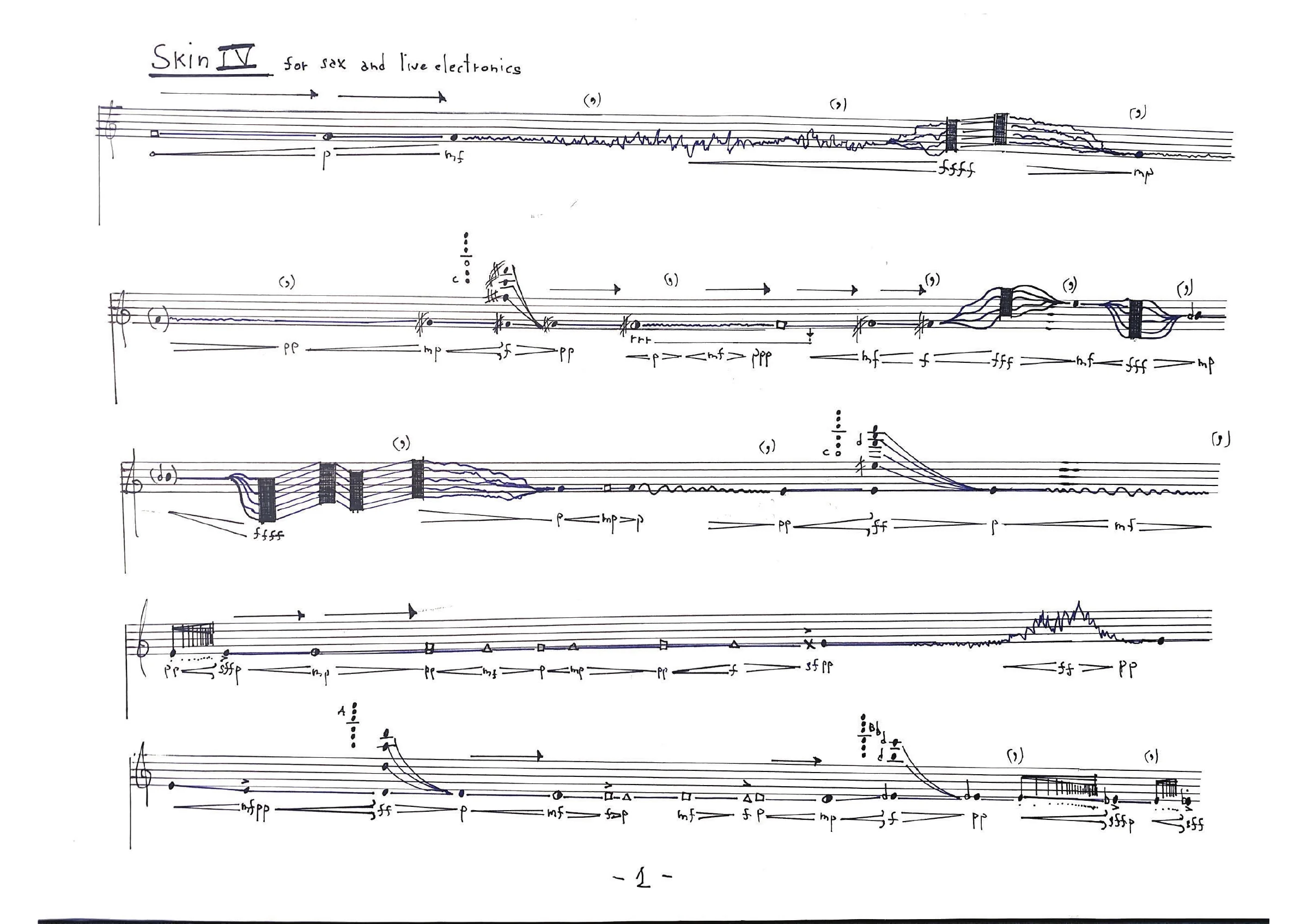
Detail from the score of Skin IV

SkinsThe skin of sound

Violin, accordion, guitar, baritone saxophone and voice: each work enters the physical matter of the instrument, with or without electronics. The cycle explores the border where sound becomes gesture and gesture becomes meaning; pressure, breath, friction and resonance preserve the imprint of the action.

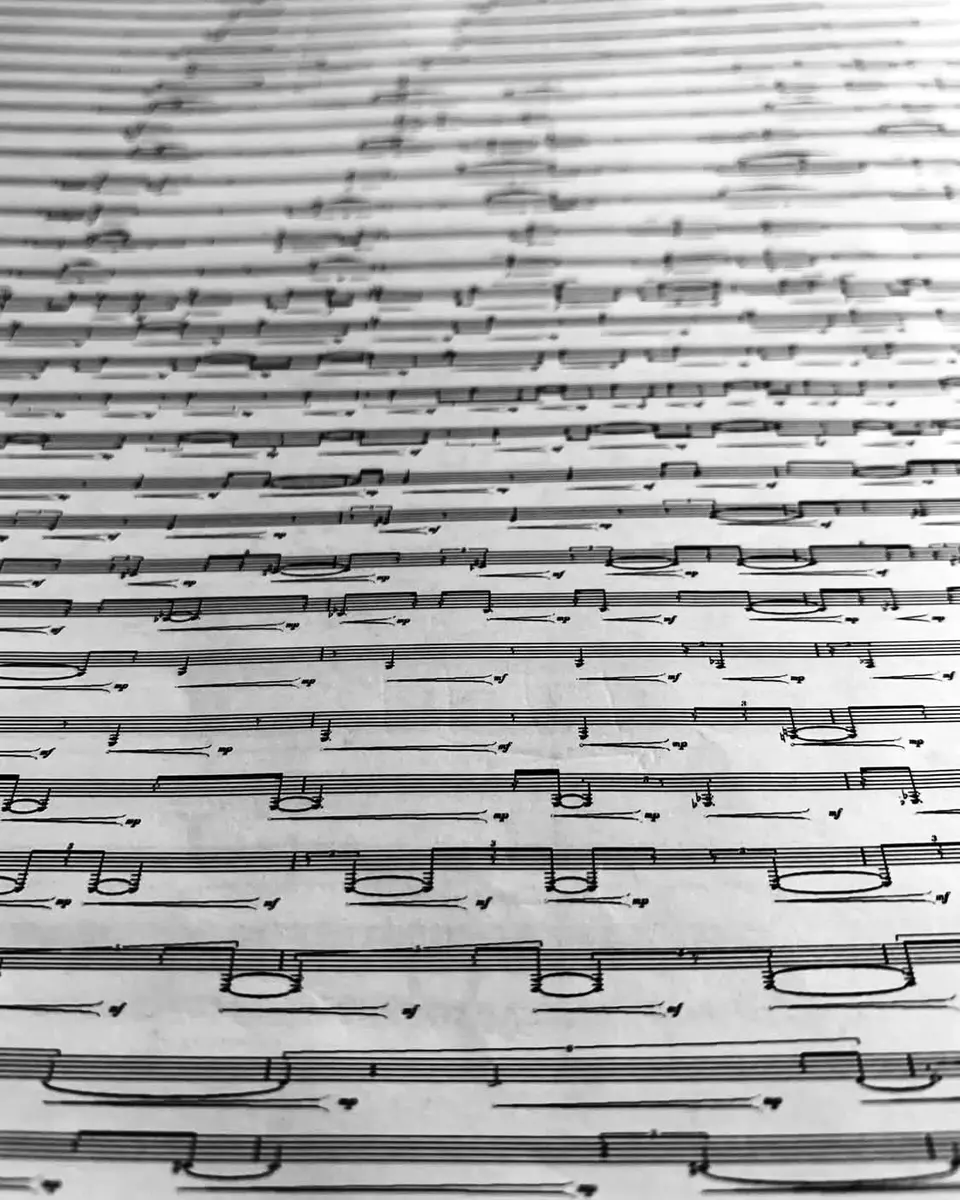
Layers of an orchestral score by Vito Palumbo seen in perspective
The score as a field of forces — layers, density and transformation

Light is a compositional category: clarity, refraction, shadow and the way orchestral colour reveals or conceals an event. In Seeds of Light, Lumen Petals and Chaconne, luminous phenomena become models for trajectories that split, overlap and reassemble. Register, articulation and resonance make light audible.

Matter is equally active. Noise, harmonics, friction, breath and electronically multiplied sound are integrated into the syntax. Extended techniques do not interrupt the discourse; they expand its vocabulary. The page may be dense, yet the sounding result seeks transparency.

Gesture links body and form. It measures energy, indicates direction and makes the movement of sound perceptible. The virtuosity of the solo concertos is never ornamental: the soloist tests the elasticity of the surrounding field, triggers orchestral reactions and sometimes becomes absorbed into a larger organism.

Historical memory enters this language through transformation. Bonn Bagatella places Beethoven under an analytical lens; Chaconne translates contrapuntal memory into an electronic polyphony of multiplied violins; Intorno a Gesualdo treats the madrigal as living material. Quotation is replaced by structural listening.

Voice and theatre constitute another laboratory. Phoneme, breath, spoken inflection and action are organised as musical parameters. The early theatre works and the Skin cycle explore the border where sound becomes gesture and gesture becomes meaning.

Across orchestra, chamber music and electronics, continuity is produced through difference. Contrasting regions remain bound by shared energies and intervallic memories. The large forms invite the listener to perceive a limited point within a wider, almost astronomical flow.

This poetics is neither technology-driven nor attached to experimentation for its own sake. Its aim is expressive precision: sound worlds in which intellect and sensibility, rigour and lyricism, visible notation and acoustic imagination remain inseparable.

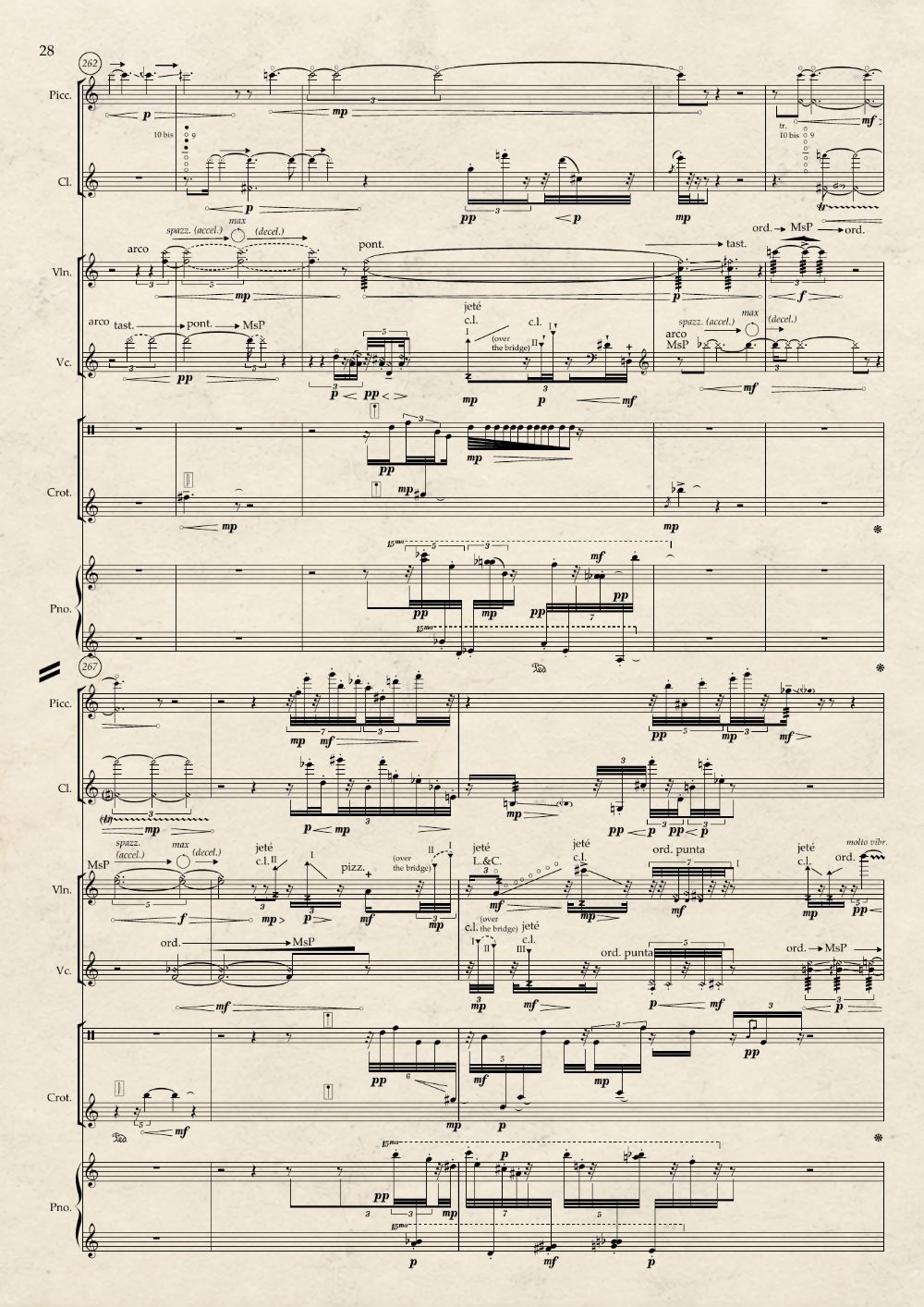
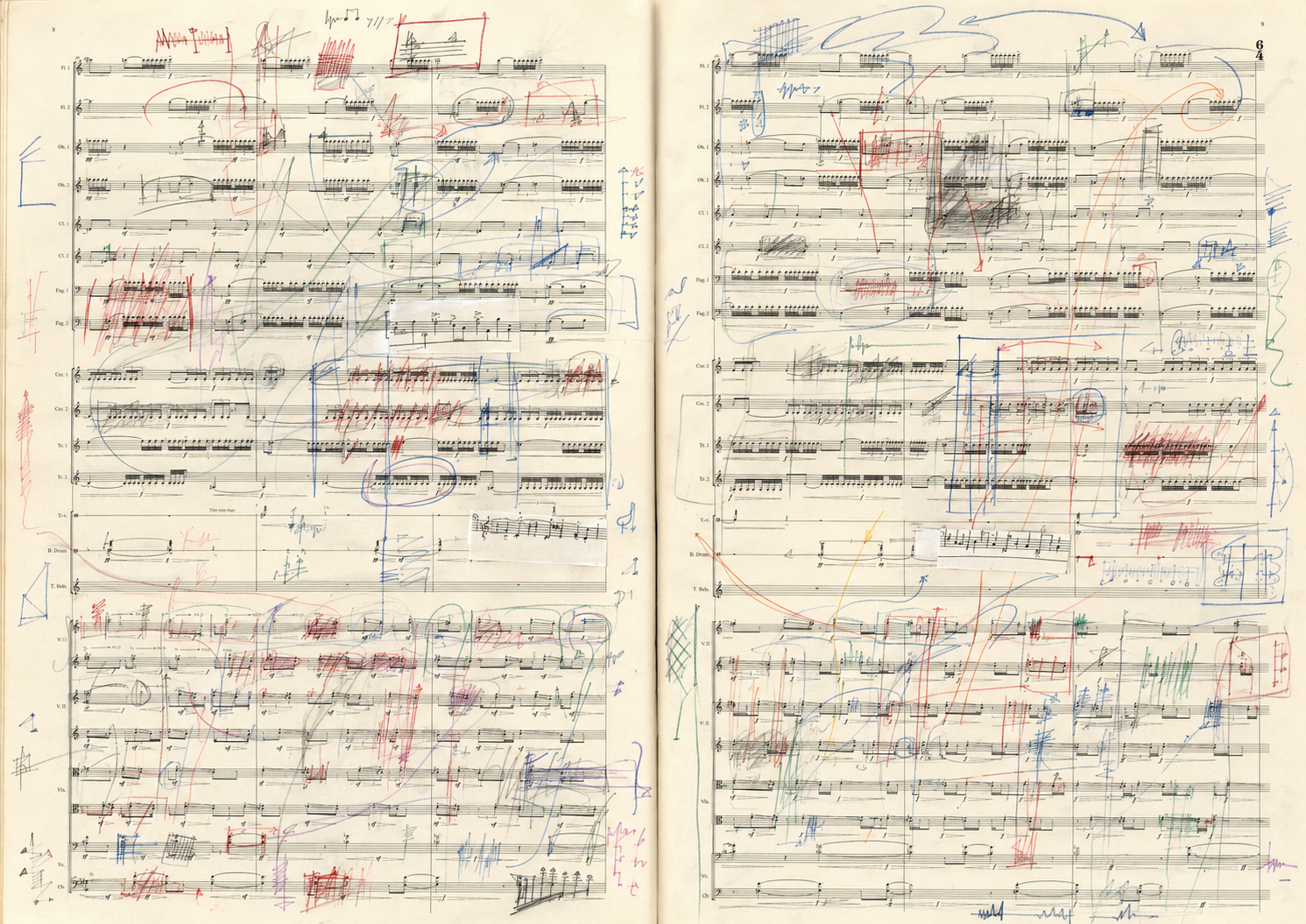
Open orchestral score from Dark Clouds with layered compositional revisions and diagrams
Dark Clouds — visual elaboration from the orchestral score

Inside the score

Dark Clouds

Orchestral matter in transformation

In Dark Clouds, musical form emerges from the continuous transformation of orchestral matter. Sound-clouds cross, juxtapose and penetrate one another, producing a large, slowly evolving movement in which no sonic condition remains stable.

Breath, key noise and friction gradually acquire pitch and resonance. Luminous major and minor triads surface from unstable textures; dense clusters may contract into a single frequency distributed across the orchestra. Elsewhere, proliferating micro-gestures lose their individual identity and merge into static, amorphous bands.

These oppositions are not arranged as separate episodes. Each material contains the possibility of becoming another. Noise can reveal harmony; density can generate transparency; apparent stillness remains internally animated. Gesture no longer acts only as a visible event but as an energy moving within the sound itself.

Here, musical time is morphological rather than narrative: it is perceived through changes of colour, density, register and resonance. The orchestra becomes a field in which light appears to be transformed into sound—and sound, in turn, into an imagined interstellar space.

A living process

Sound as living matter.

For me, composing does not mean placing sounds inside a form. It means creating the conditions in which sound can begin to behave like living matter: gathering, resisting, transforming, illuminating the space around it.

Form is therefore not imposed from outside. It emerges as the memory of what sound has undergone. A cell attracts neighbouring energies, proliferates, crosses a threshold and alters the environment that contains it. Continuity is born from these forces—from the way a resonance survives inside a new colour, or a fragile gesture returns enlarged, displaced or almost unrecognisable.

In the Piano Concerto, this process unfolds on its widest scale. The piano is neither a hero set against the orchestra nor a vehicle for virtuosity alone: it is a gravitational presence that bends time, space and colour around itself. The orchestra continually reorganises under its influence, until the final collision appears not as a conventional resolution but as the extreme consequence of everything that has accumulated.

Lumen Petals reveals the same principle at a microscopic distance. The four strings behave as a single distributed organism. Pressure, contact, speed, noise, breath and oscillation are not added effects but the grammar through which the music germinates, proliferates, mutates and remembers. Here, as throughout my work, complexity has meaning only when it answers an expressive necessity.

Light is not a metaphor placed upon sound; it is a way of making form perceptible. Timbre, register, resonance, energy and distance allow sound to emerge, diffuse, contract, fracture or disappear into shadow. From the iridescent interferences of Seeds of Light to the slowly morphing masses of Dark Clouds, orchestration becomes a means of shaping space and time—a place where the individual and the mass can continually transform one another.

I am interested in the moment when an apparently fragile musical gesture reveals an unexpected force—and changes the direction of everything that follows.

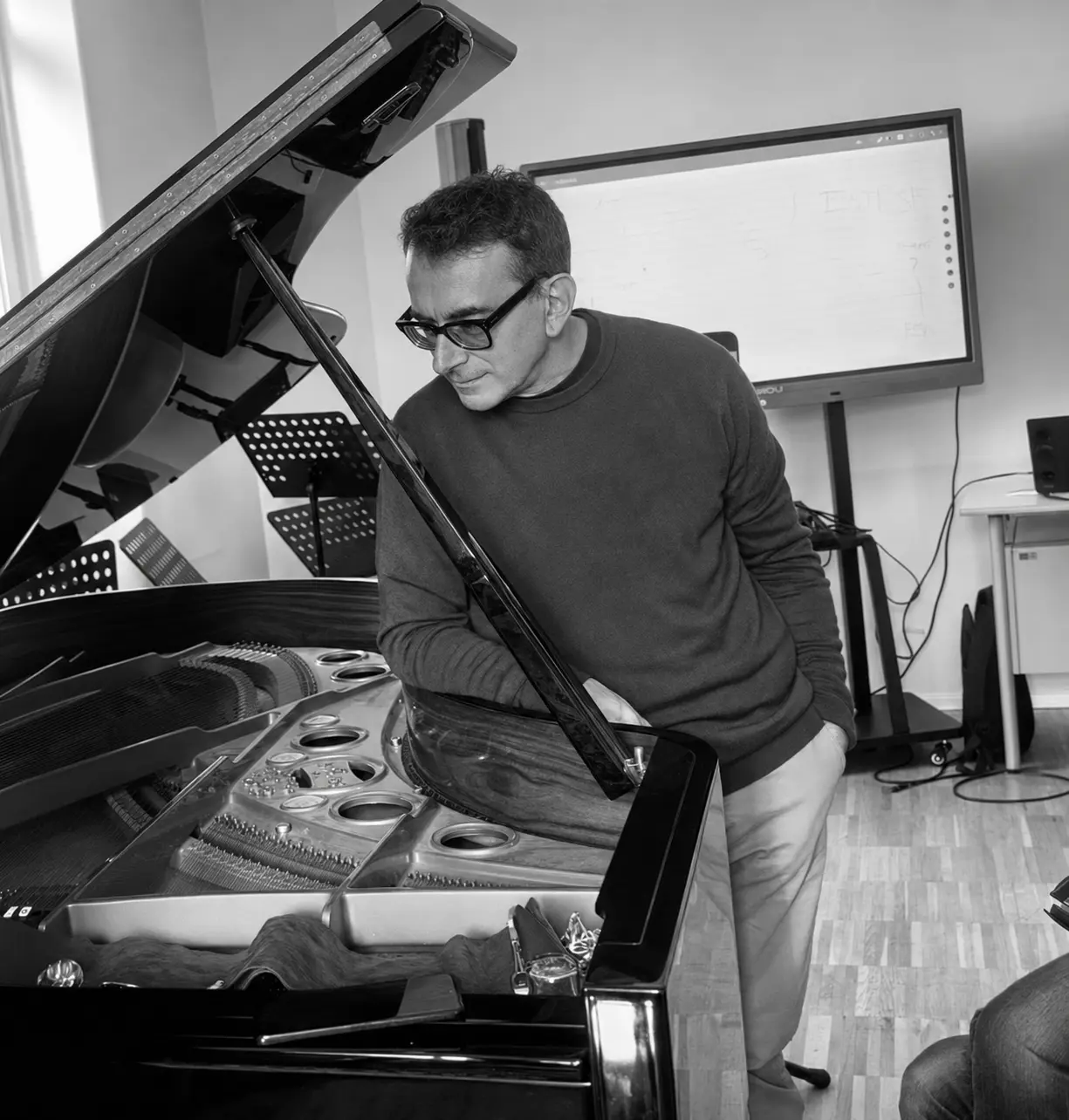
Vito Palumbo beside a grand piano, reflecting on the instrument’s resonance
Vito Palumbo — sound, gesture, resonance