
An actual work is the annihilation of the initial desire for the work; it is at once a going beyond the first idea and its negation.
Pierre Boulez
The philosopher Gilles Deleuze defined the animal as a being on the alert1. This concept is justified by the fact that an animal never knows rest, since at every moment it must watch for anything that might alter its present condition. A predator to some, it is also prey to others. Drawing on this observation, Deleuze extended the concept’s application. In his view, being on the alert, being perpetually engaged in a search, is not peculiar to animals: it also characterises writers and philosophers. In a word, the concept applies to creators.
As we can readily observe, creators also share the characteristic of being driven by research, through which they seek to push their language towards a new limit. Different approaches may be adopted in pursuit of this outcome. Creators can, for example, turn to the history of their art and thus grasp and understand the place they occupy in the present. Another approach is also conceivable: choosing to look sideways — into the present, then — to observe what is happening in other disciplines.
Although other approaches and methods of research are conceivable as ways of finding new inspiration, those mentioned above can be identified in the career of the composer Vito Palumbo. A look at his career suggests that, in his case, they have succeeded one another. His latest works — we are thinking in particular of the series of concertos and of his recent work in electroacoustic music — differ from his early compositions, which were characterised by the use of older materials. What may therefore be described as a rejection of history in favour of geography originates in his interest in fields far removed from music, such as chemistry, physics and astronomy. The diverse interactions that govern them, whether those linking atoms or galaxies, fascinate the composer, who regards them as “truly miraculous”.2
This interest in the sciences gave rise to reflection on the characteristics of sound, on its “treatment” and its “elaboration through orchestration”, as well as on the form of a work3. Giving musical expression to these concerns called for the creation of a new concept. “Sound-light” was the name its creator gave it.4 By his own account, this new approach required considerable effort and time before Vito Palumbo regarded it as an inherent element of his style.5
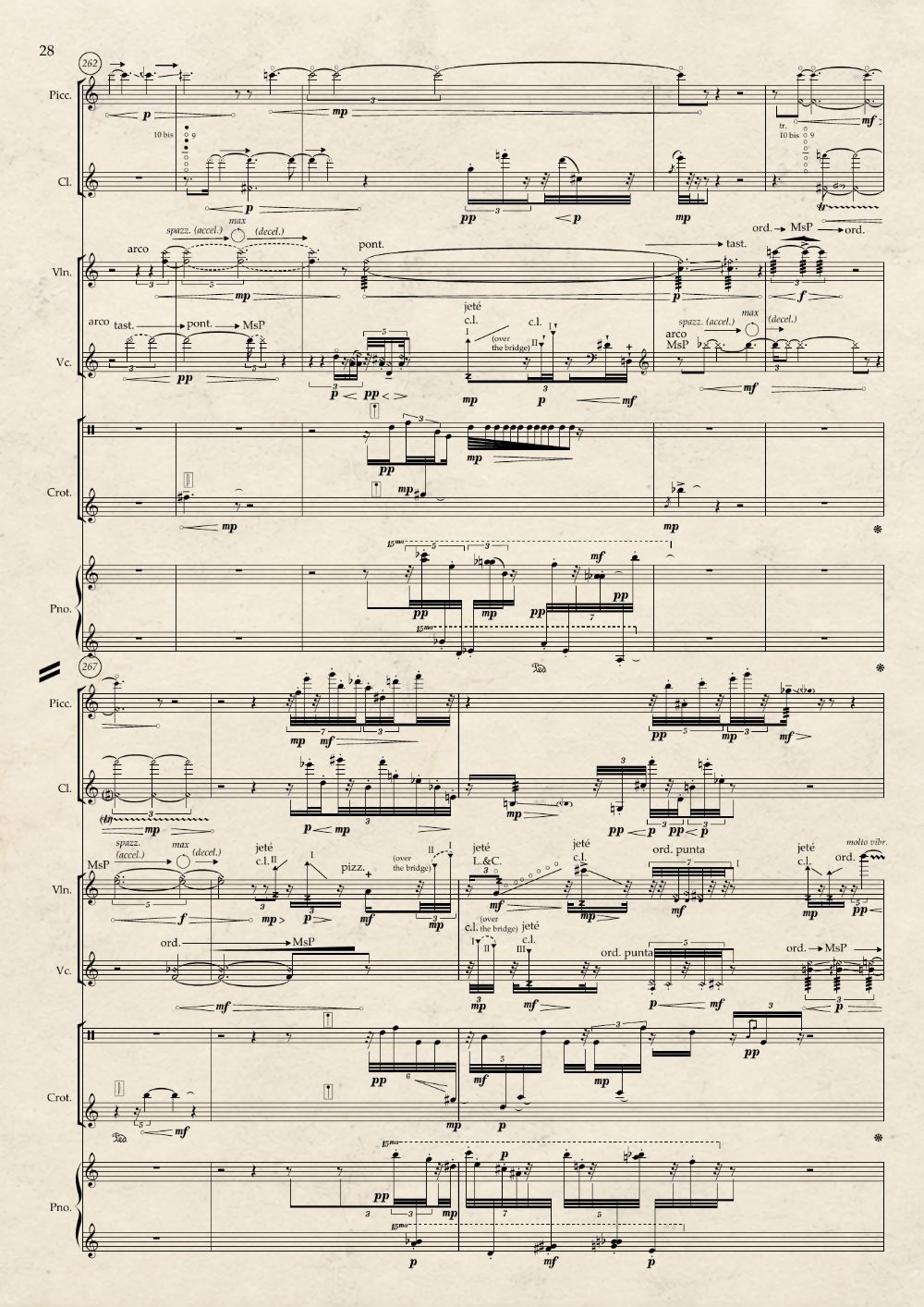
Dedicated to Paolo Rotili, Seeds of Light has a performance duration of almost fifteen minutes. Composed in 2023, it received its first performance from the Ensemble intercontemporain that same year at the Nuova Consonanza festival in Rome.6 Being close to us in time, Seeds of Light is therefore representative of Palumbo’s latest research and reflections. This work, which bears the mark of the maturity of the “sound-light” concept, will be the subject of the following analysis.
The ensemble
Instrumentation
Seeds of Light is written for an ensemble of six players. Its performance requires a flute (doubling piccolo), a B-flat clarinet, a violin, a cello, a piano and seven types of percussion: crotales, woodblocks [5], xylophone, tom-toms [4], snare drum, glass bottles of different sizes [4] and rototoms [4].
The almost constant presence of these players throughout the work is noteworthy. Apart from minor exceptions, only bars 229–248, marked by the absence of percussion, stand out significantly from the rest of the score.
During the performance of Seeds of Light, the flautist and percussionist are required to use several instruments. A logic can be observed in these changes: for the listener, they produce the perception of an evolution in a given instrument’s timbre rather than its replacement. The use of a new instrument entails, in the same movement, the definitive silencing of its predecessor. Thus the flute, present from the beginning of the work, gives way permanently to the piccolo from bar 241 onwards.
Although subject to the exceptions we shall identify, this pursuit of a progression in sound is also found in the percussionist’s part. The main exception concerns the crotales, whose use can be observed on three occasions in the score. While Seeds of Light opens and closes with them, they also make an appearance between bars 249 and 277, after the brief passage in which the ensemble was not at full strength. By reappearing at this particular point, the crotales call on the listener’s memory while also giving the work fresh impetus.
Another point must be noted about the use of percussion. Unlike the flautist, the percussionist offers the composer the possibility of moving rapidly from one instrument to another (alternation), or of playing two instruments at the same time (simultaneity). Although Seeds of Light displays both approaches — alternation between woodblocks and xylophone in bars 143–149, and simultaneity between crotales and glass bottles in bars 261–277 — they do not constitute a characteristic feature of its writing. Since they are brief and do not recur, alternation and simultaneity remain relatively incidental. Nevertheless, these uses suggest that the choices are intended to avoid an abrupt change or, in other words, to make it gradual, like a runner reaching maximum speed before taking the baton. This reading is strengthened, moreover, by an examination of the score as a whole. Throughout it, a rest lasting from a few beats to several bars can be observed between the use of one percussion instrument and another. This interval is certainly necessary for the player to move to another instrument, but it also allows listeners to detach themselves from the former timbre while preparing to receive the new one. Thus, despite the use of crotales discussed above, Seeds of Light resembles a book made up of different chapters, each recounting the adventures of six players who change as their adventures unfold.
Playing techniques
The instruments are played using a wide variety of techniques. These possibilities for timbral variation contribute greatly to the constant contrast experienced by the listener. The different sounds produced by the players acquire another dimension in this work and are consequently appreciated differently. By working with dynamics, pitch and duration, Vito Palumbo becomes a sculptor of sound. Through his choice of timbre and playing technique, he becomes a painter revealing the sonic palette an instrument has to offer.
This work on, and exploration of, sonority sometimes finds its solution in writing that grants the player freedom. In these rare moments, what is written in Palumbo’s score is no longer what the player must do, but what they may perform within a defined field. In other words, on reading the score, the player is informed of the direction to take, but it is for them to choose how far to go. Such is the case with the clarinet, which in the penultimate bar is asked to play harmonics irregularly over a wild staccato. Another example is found in the strings, where instructions include “play the highest possible note on a given string, or perform an irregular glissando combined with a wide vibrato”. These apparently uncontrolled sounds give performers freedom in their gestures, allowing them to impart their own sensibility.
Form
The constant presence of the full ensemble noted above helps make the overall form difficult to discern. Palumbo’s description of Seeds of Light as “a progressive transformation of sound matter, like a liquid sculpture” suggests that the piece is governed by a general idea of progression7. It would therefore become very difficult, both for someone analysing the score and for someone listening to it, to divide the work clearly into distinct parts.
But would that not amount to an admission of failure on our part? Although the study we are presenting does not establish the overall form definitively, it nevertheless offers, we hope, some keys to understanding and appreciating it. By examining the percussion entries, double barlines, fermatas and the relationships between them, we shall try to reveal the work’s underlying structure while also showing how the idea of progressive form finds its full place within it.
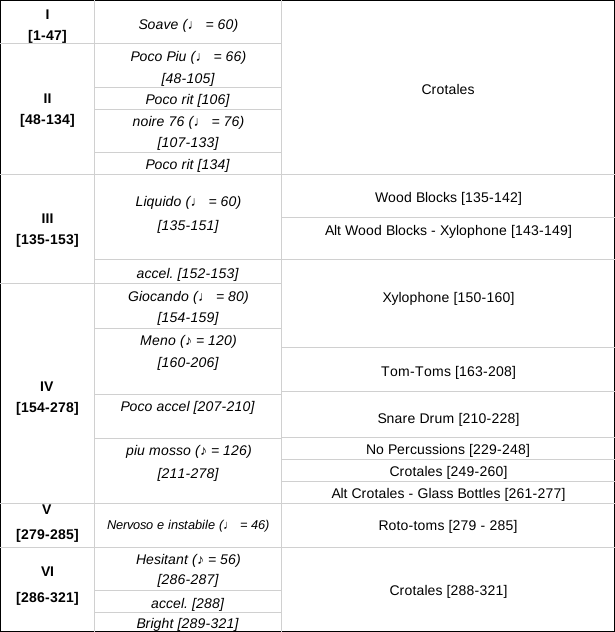
Double barlines mark out the score, dividing it into six sections of markedly different lengths. This disparity creates a strong imbalance between the sections. For example, the penultimate part contains only seven bars (279–285), whereas the preceding section (bars 154–278) exceeds one hundred.
These sections differ not only in length: tempo must also be taken into account. Each has its own tempo and, as it unfolds — with the exception of the first and fifth sections — includes markings that introduce variations in it. Perceived by the listener, these agogic markings unsettle their orientation, making an overall understanding of the form more difficult.
A fermata brings about a temporary suspension of tempo. For the listener, it is a strong signal that a particular moment has ended. If we exclude the final one, in the last bar, there are three fermatas in Seeds of Light. They occur in bars 47 (before the second part), 134 (before the beginning of part III), and before the beginning of part IV, in bar 153. In other words, when measured against the work’s total number of bars, they occur in its first half! Through these fermatas, the listener initially perceives a music that does not hesitate to announce, by means of a temporary pause, both its current stage and, in the same movement, its future progression. In sections IV and V, however, it will take on a very different guise. Here, by dispensing with fermatas, perpetual progression is fully embraced.
One final observation about the fermatas concerns their nature. Only the first two are long; the third is short. Less emphatic than its predecessors in its demand for a suspension of time, it heralds a music that will subsequently move away from what it has been, continuing, as we have seen, without interruption.
Of all the players, the percussionist plays the greatest number of instruments. Their use over the course of the piece also provides a possible reading of the overall form of Seeds of Light. When set against the form indicated by the double barlines, the percussion reveals a dual approach. Reading the beginning of the score enables us to grasp a logic, but we must acknowledge that it rapidly eludes us as the work progresses. The first two sections are devoted to crotales. Part III, by contrast, uses two percussion instruments: woodblocks and xylophone. Taking advantage of its considerable length, section IV intensifies this increasing introduction of instruments. The xylophone, already present in part III, occupies 7 bars before tom-toms and snare drum succeed it. There follows the absence of percussion already noted in bars 229–248, during which the piano acquires a more melodic gesture. Finally, crotales and glass bottles bring this fourth stage to a close. The final two sections contrast with part IV: they reject its use of several percussion instruments and return to the logic observed at the beginning of the work. Only rototoms inhabit the fifth part, while crotales conclude the composition.
As we have observed, Seeds of Light can be divided into six stages that facilitate an understanding of the work. This division alone, however, cannot account for its underlying structure: other logics operate beneath it. While one may sometimes accompany that division, others play with it, making it less perceptible. Since none of these logics coincide at the same moment, the score, reassembled as a whole, presents a multifaceted work that can be read in different ways, yet in which the pursuit of a progressive gliding movement always predominates.
Conclusion
The constantly progressing form of Seeds of Light, the use of advanced sound-production techniques, and the interplay of the instrumental writing all contribute greatly to the creation of Palumbo’s “sound-light” concept. Listening to this composition, one understands that these three aspects are intimately linked and are necessary ingredients in the concept’s realisation.
Listeners to Seeds of Light find themselves perpetually immersed in the present. It is difficult for them to hold on to a particular element in order to orient themselves within the work. Every note’s sole role is to conclude the preceding one while introducing the next. The idea of progression is therefore dominant. This constant progression, this instability, leads directly to the idea of contrast: here are some of the ingredients necessary for creating a “sound-light”.
The analysis we have proposed, though incomplete, raises the question of whether Palumbo, in this recent composition, fulfils the dream of illustrious predecessors. Assigning a colour or a human feeling to a note, a mode or a key is not a new ambition. One recalls, for example, Arnold Schoenberg, who included lighting directions to accompany the music in the score of Die glückliche Hand. Yet such examples reveal that the composer was seeking colour outside music. For colour to emanate from music itself, it had to arise both from the note and from the overall form, which itself must be in constant progression. In other words, the infinitely small — the note — must enter into dialogue with the infinitely large — the form. While the note does not sum up the form, it participates in its creation; the form, in turn, needs the note in order not to collapse in upon itself.
Notes
- Gilles DELEUZE, « A comme animal », L’abécédaire de Gilles Deleuze, Pierre-André Boutang, Michel Pamart, éd., 1995. ↩
- https://www.ensembleintercontemporain.com/fr/2023/10/grains-de-lumiere-entretien-avec-vito-palumbo-compositeur/ Accessed on 01/09/2026 ↩
- https://www.ensembleintercontemporain.com/fr/2023/10/… Accessed on 01/09/2026 ↩
- https://www.ensembleintercontemporain.com/fr/2023/10/... Accessed on 01/09/2026 ↩
- “It has allowed me to slowly build what one might call ‘style’, with great effort and over a long period of time until today. It has evolved over the years going through various stages of experimentation and research, to arrive at what I now consider something truly consolidated in my poetics.” Quotation originally in English. https://15questions.net/interview/fifteen-questions-interview-vito-palumbo/page-1/ Accessed on 01/09/2026 ↩
- https://www.ensembleintercontemporain.com. Accessed on 01/09/2026. ↩
- https://www.ensembleintercontemporain.com/fr/2023/10/… Accessed on 01/09/2026 ↩